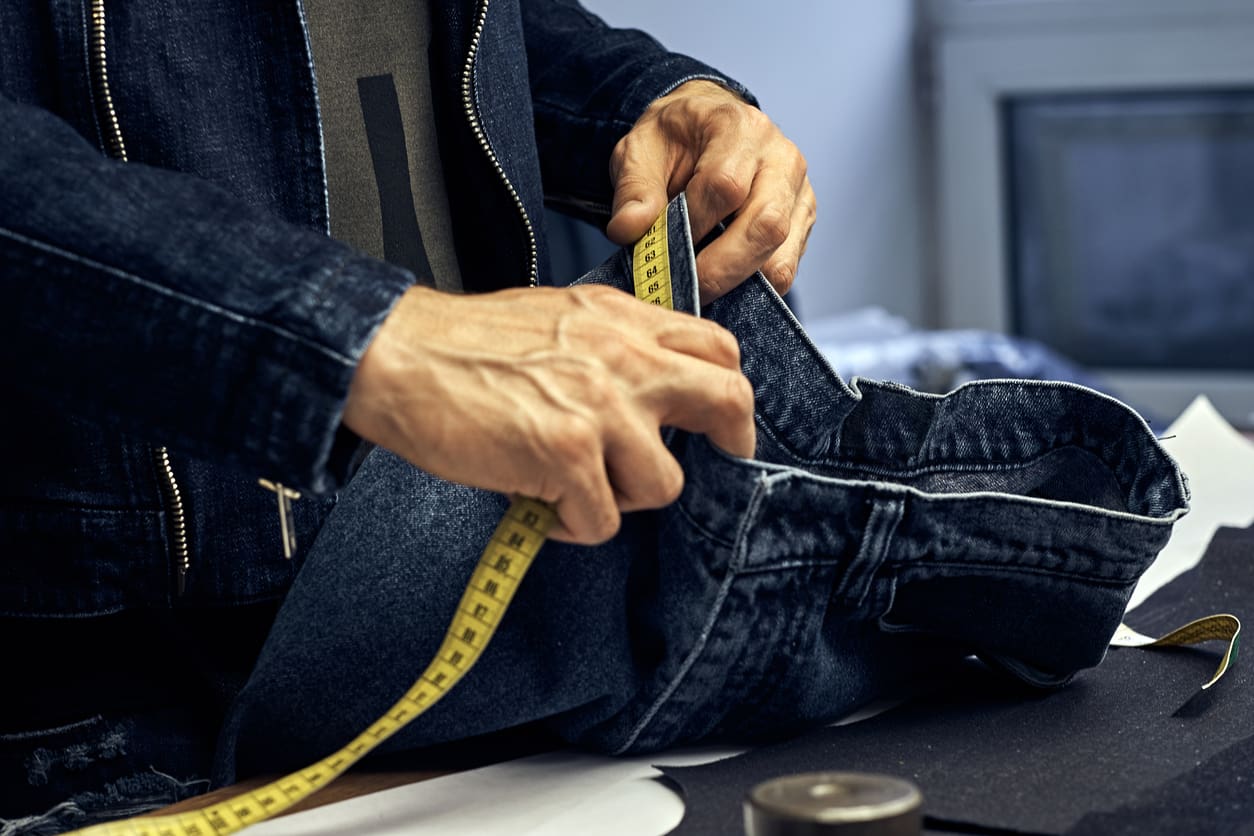
Walk into any alterations shop and describe your fit problem. The tailor will nod before you finish your sentence. Not because they're not listening, but because they hear it every single day. The waistband that gaps at the back. The sleeves that cover your hands. The trousers that are right everywhere except the legs are too wide.
These aren't unusual problems. They're the seven most common issues. And they all have a standard fix.
Trouser length is visible from across the room. It’s the first thing people notice about how well clothes fit. If your pants bunch over your shoe or drag the floor, everything else – the cut, the color, the fabric – stops mattering.
The fix: hemming to your correct break length.
There are three standard break options:
Bring the shoes you’ll wear with them. A flat loafer and a two-inch heel change where the hem needs to land. Same trousers, completely different measurements.
Beyond length, break choice affects proportion. A cropped no-break hem pairs naturally with a slimmer ankle cut. A full break needs more volume through the leg to look intentional. If you’re unsure which break fits your pants style, your tailor can guide you at the fitting; it’s part of the consultation, not an extra step.
The pants fit at the hips. They fit at the thighs. But every time you sit down or bend forward, the waistband pulls away from your back. This isn’t a body problem. It’s a sizing problem.
Standard sizing assumes a fixed waist-to-hip ratio most people don’t actually have. Anyone with a fuller seat or a narrower waist relative to their hips runs into this constantly. Off-the-rack clothing wasn’t built for real body variation.
The fix: taking in the center back seam of the waistband.
This narrows the waist independently without touching the seat or hips. The adjustment hides inside the waistband. It’s completely invisible from the outside. If the gap is larger than about 1.5 inches, a tailor may also adjust the back rise (the distance from the waist to the crotch seam) to keep the proportions right.
Yes. The same center back seam adjustment applies to skirts with a fitted waistband. Pencil skirts and A-line styles with a defined waist are both good candidates. The key question at the fitting is whether the gap is uniform all the way around or concentrated at the back, which determines exactly where the adjustment is made.
When jacket sleeves swallow your shirt cuff entirely, the jacket looks too big, full stop. It doesn’t matter how well it fits everywhere else.
The standard: 1/4 to 1/2 inch of shirt cuff should be visible below the jacket sleeve. That small strip of white (or contrast) is what communicates a fitted, intentional look.
The fix depends on the jacket:
Take the dress shirt you’ll wear with the jacket. Sleeve length is calibrated to the cuff, not a fixed measurement.
For unlined casual blazers or sport coats worn without a dress shirt, the sleeve should end where the wrist meets the hand. A good tailor will check the length while you stand naturally with your arms at your sides, not stretched out, since arm position affects the measurement.
The shoulders sit right. The length works. But the fabric hangs away from your torso like a paper bag. The blouse looks worn rather than chosen.
The fix: taking in the side seams.
This narrows the body of the top without touching the shoulders, neckline, or armhole. The seams are hidden and invisible from the outside. The result: the same garment, shaped to you instead of hanging away from you.
Good candidates for this alteration:
If the top needs more than 3 inches taken in, additional seam work may be required to maintain the geometry of the garment. Your tailor will flag this at the fitting.
For structured woven tops, no, the fit improves without changing how the fabric moves. For flowy or bias cut tops, a skilled tailor will take in the seams gradually to preserve the drape. Mention the fabric type when you take it in so your tailor can plan the approach accordingly.
The shoulder seam sits halfway down your upper arm. The jacket or dress hangs off your frame and makes everything else look oversized. This is one of the more complex clothing alterations on this list, and one of the most impactful.
The fix: shoulder seam reduction.
Moving the shoulder seam toward the neck brings it in line with your natural shoulder. Because the shoulder seam is structural, this adjustment also affects the sleeve, the armhole, and the body of the garment, which is why the cost is higher and the turnaround is longer.
Honest guidance:
Put on the garment and check the shoulder seam placement first. If it sits more than half an inch past your natural shoulder line, that’s a shoulder fit issue. If the seam is close but the whole jacket feels baggy through the chest and back, the problem is overall size, not just the shoulder. Take it in for a fitting before assuming the most expensive fix is the right option.
Standard dress lengths are cut for a taller-than-average frame. If a midi hits you at the ankle instead of below the knee, or a maxi skirt drags, the whole proportion of the look changes. A hem alteration fixes it.
Hem complexity varies by skirt type:
The shoe rule applies here, too. For dresses, especially, heel height dramatically affects where the correct hem point lands. Bring the shoes.
Sometimes. It depends on how much fabric was left in the original hem allowance when the dress was made. Most quality garments leave 1 to 2 inches. Your tailor can check the inside of the hem at the fitting. If there’s enough fabric, letting it out is straightforward. If there isn’t, they’ll tell you before any work is done.
You have older trousers that fit everywhere except the legs, which look wider than anything else in your closet. Paired with a modern fitted jacket, they read dated fast. Tapering is the fix.
The fix: tapering the leg from the knee down, or from the thigh for a more dramatic change.
This narrows the leg without changing the waist, seat, or rise. The waist and seat have to fit correctly first; if they also need work, those adjustments come before tapering.
One expert note:
On heavily patterned or striped fabric, tapering can disrupt the pattern alignment. A good tailor will assess the specific fabric before committing to the work. Mention the pattern when you take in the pants.
If the trousers are well-made and fit correctly at the waist and seat, tapering almost always costs less than replacing them with something comparable. It’s especially worth doing on dress trousers, structured wool pants, or any piece with quality fabric that newer off-the-rack options don’t match. If the pants are lightweight fast fashion and every seam needs work, that’s a different math problem.
Every fit issue on this list has a solution, and most of them are faster and more affordable than buying something new. If you’ve been holding on to an almost right piece, one appointment is all it takes to make it wearable again.
At Pepper Square Cleaners, our staff tailor has been handling exactly these kinds of fixes – loose hems, gaping waistbands, sleeves that swallow your cuffs – since 1979. We take the time to understand what’s wrong with the fit before we touch the garment, so the result is right the first time.
Drop it off, describe the problem, and let us take it from there.
Contact Us:
📍 14902 Preston Road, Suite 902, Dallas, Texas, 75254
🕒 Monday through Friday, 7:00 AM to 6:00 PM | Saturday, 7:30 AM to 5:00 PM | Sunday: Closed