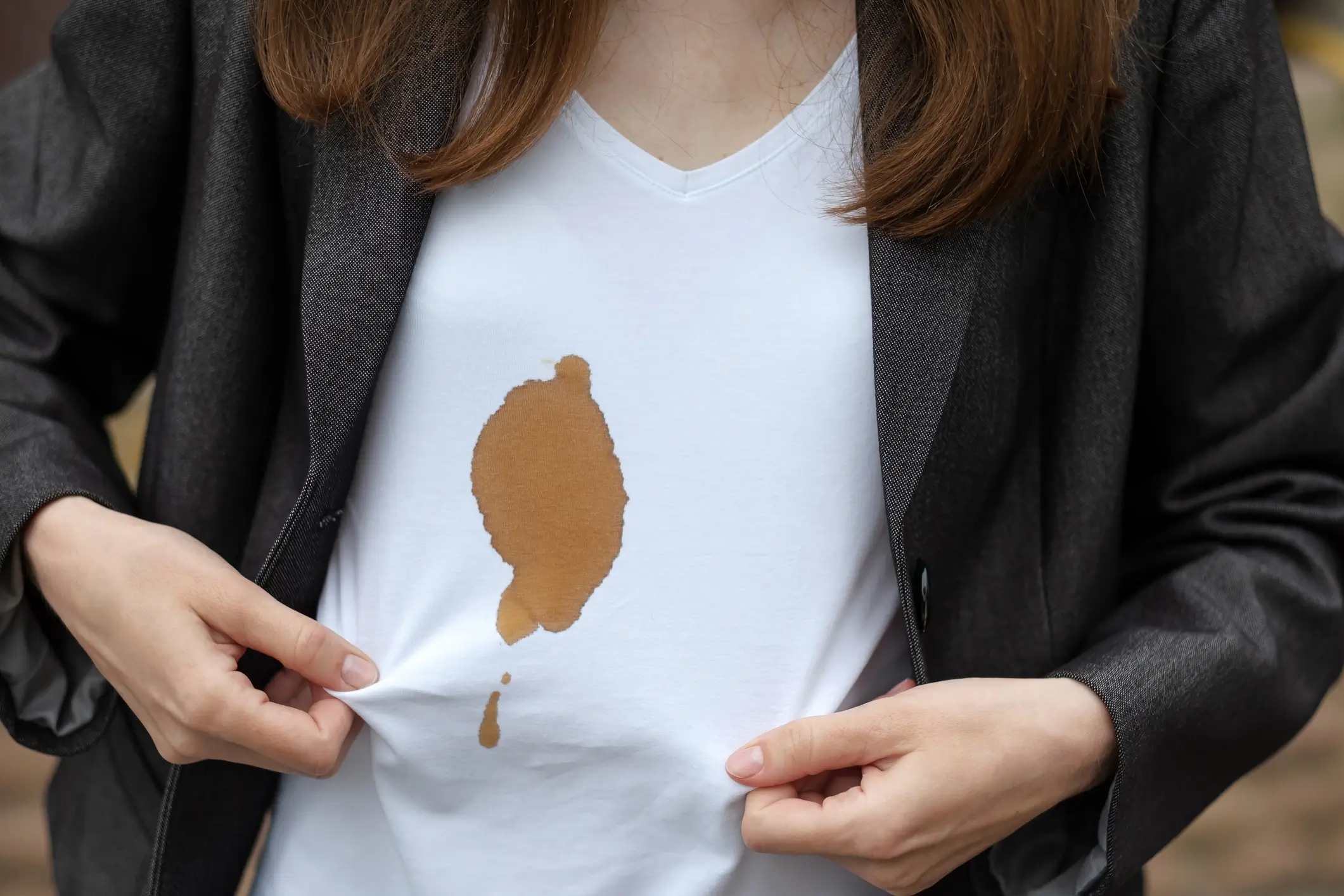
Put down whatever's in your hand. The garment doesn't need more effort right now; it needs less. Every stroke works against the outcome you're trying to achieve, spreading contamination further than the original spill ever reached on its own.
Stains don't get worse by themselves. They get worse through continued handling, which is exactly what's happening under that cloth right now. Before you reach for dry cleaning or anything else, the first move costs nothing: stop, set the garment down, and let the next thirty seconds be those that actually help.
Scrubbing feels productive because you can see your hand moving and the cloth working the spot. In reality, it's three kinds of damage at once. It spreads the stain into fabric that was clean a minute ago. It abrades the fibers, distorting the weave and dulling the surface.
And it forces the staining material deeper into the fabric, past where surface treatment can reach it. These effects stack, so a stain scrubbed for two minutes ends up in worse shape than one left alone for two hours.
A fresh stain has soft, slightly damp edges and even color throughout. A set stain looks different: darkened edges forming a ring, a stiff center, and fabric that's slightly puckered from rubbing.
If you see any of that, stop trying to fix it yourself. Bag the garment and get it to a cleaner soon, since the window for easy removal has already narrowed.
Tannins don't sit on top of fabric; they bind to it, and that bond strengthens with contact time and agitation. Scrubbing supplies both.
It works the pigment deeper into the fibers while smearing it across a wider area, so a coin-sized spot becomes a faded halo covering twice the space. The stain isn't gone at that point, just spread thin and set deeper, which is a worse starting position than doing nothing at all.
Wine gets the headline, but the same binding behavior shows up with coffee, black tea, dark berries, and balsamic vinegar. Treat any of these with the same urgency, since tannin stains are genuinely time-sensitive in a way some other stains aren't.
Oil behaves differently because it doesn't bond chemically; it just settles into and around the fibers. Scrubbing pushes it two directions at once: deeper into the weave, and outward into the surrounding fabric. That's why an oil mark often looks bigger and lighter after you work on it. It isn't lifting; it's spreading and thinning across more surface area.
Salad dressing, cooking splatter, hand lotion, and sunscreen all cause the same reaction, and none look alarming when they happen. That's the problem. Because they don't look urgent, people rub at them absentmindedly while multitasking, which is exactly the kind of scrubbing that does the most damage.
Ink is the fastest of the five to show visible damage, which makes it a useful gut check if you're unsure whether or not to stop. Mechanical action combined with moisture spreads ink almost instantly, so a small, contained mark can become a diffuse cloud several times its original size within seconds. If you want proof that scrubbing spreads stains rather than removing them, ink shows it fastest.
Not all ink acts the same way. Ballpoint is oil-based and smears in one direction under pressure. Gel ink is water-based and spreads more evenly, closer to a tannin stain. Permanent marker resists water but reacts to alcohol-based products, activating an otherwise stable stain. Treat all three as fragile until a professional identifies which one you're dealing with.
Blood is the stain where your instinct is most likely wrong twice over. Beyond the spreading problem every stain shares, protein-based stains set permanently when they meet heat.
The combination that feels most thorough – warm water and vigorous rubbing – is precisely the combination most likely to lock the stain in place for good. Here, doing less genuinely protects the outcome more than doing more.
Sweat, dairy, and egg all set with heat the same way as blood. If a garment has any of these on it, cold water is non-negotiable, and that rule matters more than any product for which you might reach next.
This one is about the material, not the substance on it. On delicate or structured fabrics, scrubbing damages the garment itself, regardless of what caused the stain.
It abrades silk until it loses its sheen, felts wool into a matted texture that won't relax back out, and can entirely distort the shape of a structured piece. You can succeed at removing the stain and still end up with a garment that looks worse than before you started.
Shoulder pads, boning, structured linings, and delicate trim are all signs a piece needs professional handling no matter what's on it. If you're not sure if something qualifies, treat it as delicate. Guessing wrong in the cautious direction costs you nothing. Guessing wrong the other way can cost you the garment.
Once you stop scrubbing, here's what actually helps in the next few minutes:
Bleach, vinegar, and baking soda paste are common instincts, and all three can make things worse. Bleach can permanently discolor anything that isn't white.
Vinegar can react badly with certain dyes. Baking soda paste, left on too long, can dry out and stiffen delicate fibers. None of these is a safe default, so if you haven't reached for one yet, don't start now.
Is dry cleaning better at removing stains than what you can do at home? Honestly, yes, but not for the reason most people assume. It's not that a dry cleaner has access to stronger chemicals sitting in a back room. The real advantage is identification and process.
A professional identifies the actual stain, matches a specific treatment to it, and checks the result between stages before deciding what to try next. A home attempt tends to become one general-purpose method applied with increasing force, the opposite of what most stains need.
The garment gets inspected under better light than most people have at home, and the fiber content and stain type are identified together before any treatment is chosen. That treatment is applied, checked, and adjusted before moving forward, rather than repeated blindly. That staged, evaluated approach, not a stronger product, is the real difference.
If you're staring down at one of these stains right now, the fastest way to protect that garment is to stop treating it yourself and bring it to us instead.
At Pepper Square Cleaners, we inspect every stain before we touch it, then match the treatment to the fabric and stain type instead of guessing and hoping for the best. We're also the only cleaner in Dallas offering true same-day dry cleaning – in by 10:00 AM and ready by 2:00 PM – six days a week, so a stain that has you worried this morning doesn't have to follow you into tomorrow.
For anyone searching for professional dry cleaning in Dallas, we're a family-owned dry cleaning business right here, and we get your clothes back safely and on time every day.
Address: 14902 Preston Road, Suite 902, Dallas, Texas, 75254
Phone: +1 469-535-7074